Dance guide
The valle: Albania's circle dance
What the valle is, how Albanian dancing differs between north and south, and why the k'cimi of Tropojë joined UNESCO's list in 2024.
Hold a place at the show ↗The word and the dance
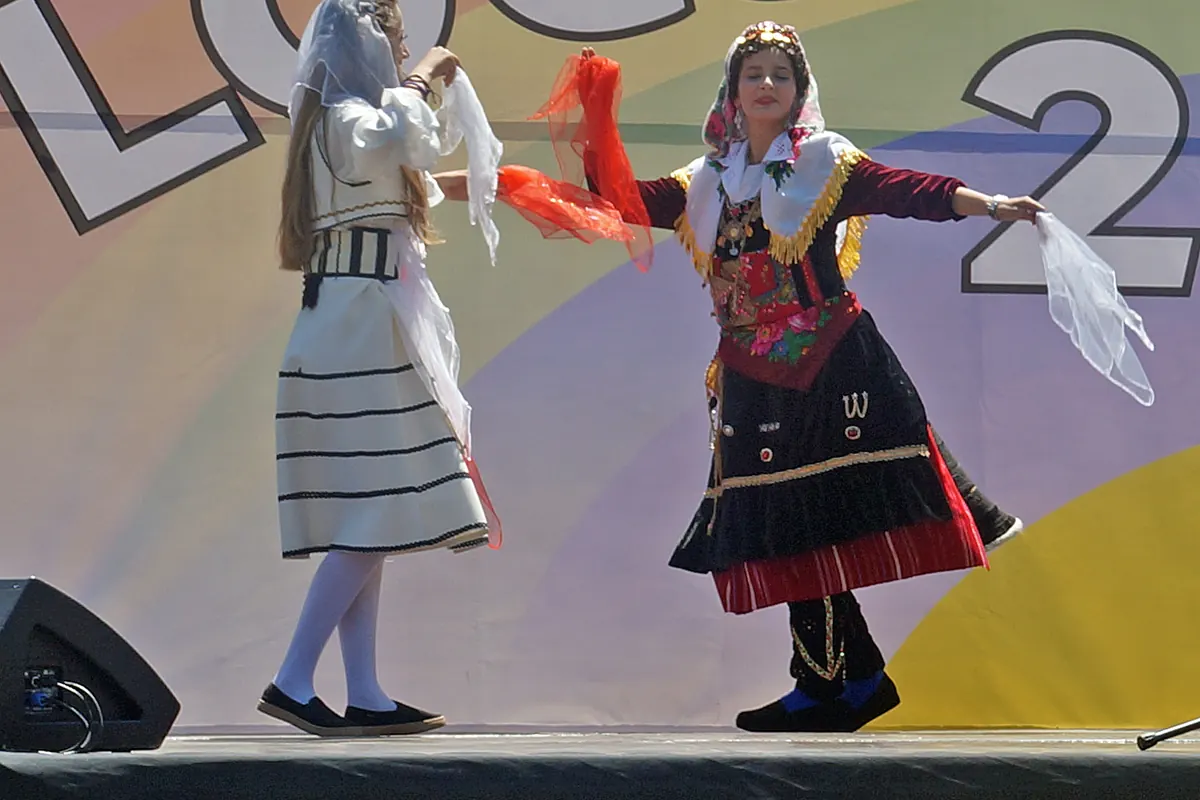
Valle is the Albanian word for a circle folk dance. The definite form, vallja, appears in the names of many dances, usually followed by a place or a character, such as Vallja e Tropojës or Vallja e Çobanit. Wikipedia's list of Albanian dances stresses that every region has its own, and the list is admittedly incomplete. So there is no single valle, only a family of dances that share a habit: people move together, often in a ring, to music played for the occasion. That is useful to remember at a show, because the dance you are pulled into may be one that a different region would not recognise as its own.
North and south
Wikipedia's article on Albanian culture draws a contrast. The Ghegs of the north typically dance solo, while Tosk dances in the south are more social and are performed in lines and semicircles. Regional dress and music change with the dance. For a visitor this explains why a show with songs and dances from several regions looks varied: a northern piece may feature individual footwork and a southern one a long line of dancers moving as a unit. It is a generalisation, not a rule, and the dances travel: UNESCO notes that the northern k'cimi is now danced by people from other parts of Albania too.
The k'cimi of Tropojë
UNESCO inscribed the k'cimi dancing of Tropojë on the Representative List in 2024. It describes a festive dance usually accompanied by drums, performed by men, women and children of all ages, mostly in couples, face to face without touching. Dancers make swooning movements, raising and dropping their arms, and women may wave a red handkerchief. The dance is tied to springtime, mountain landscapes and the flight of eagles. UNESCO notes it is now danced year-round, including by people from other parts of Albania.
Where the valle is danced
UNESCO says the k'cimi appears at spontaneous gatherings and at ceremonies such as weddings, birthdays, initiations and village celebrations, and that children learn it from elders at family events by watching and joining in. That is typical of Albanian circle dances in general: they belong to the occasion rather than the stage. Tirana's tourism office describes the same logic in the wedding that Albanian Night stages, where dances welcome the bride and then guests are invited to join the circle.
Joining in at Albanian Night
Guests at Albanian Night are asked into the circle, and the venue says local dancers guide you through the valle. You do not need any dance background; the steps are taught in the moment, and the other guests are learning too. Watch the feet of the dancer ahead of you, keep the rhythm before you worry about the pattern, and let the circle carry you. The show also leaves room to stand back and clap if you would rather watch. A separate valle lesson exists at the venue for anyone who wants more time to learn the steps, which you can ask about at the desk.
The music under the dance
Wikipedia's article on Albanian culture says music varies by region. In the north, Ghegs are known for sung epic poetry accompanied by the lahuta, a stringed instrument used mostly in northern Albania and Kosovo. In the south, ensembles often combine violins, clarinets, the lahuta and the def, a frame drum, and Tosk music is described as soft and polyphonic. UNESCO's note on the k'cimi mentions drums. When you dance at a show, the instruments tell you which region the piece belongs to before the steps do.
Dances you may hear named
Tirana's tourism office mentions several dances in its description of the evening: a dance of Tirana with characteristic costumes, the Osman Taka dance, which it tells as the story of a young man freed after dancing so well, and the circle dances Tumankuqe and Pogonishte. Which dances are performed on a given night is for the ensemble to decide, so treat the names as a glossary for listening rather than a programme.
Sources